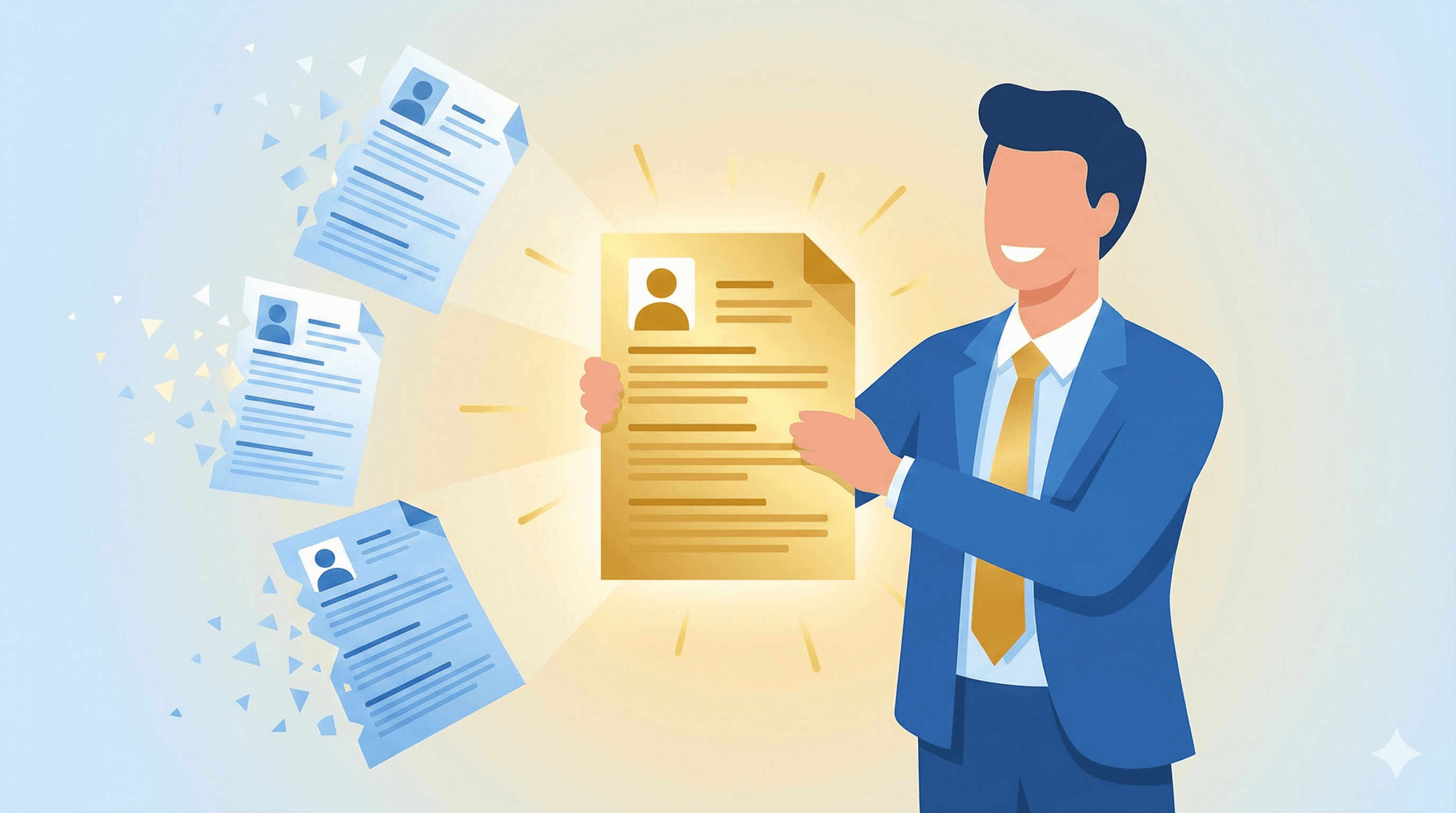
You have more experience than ever, but as The Ladders eye-tracking research confirms, every article keeps telling you the same thing: keep a one page resume. Then you open a job posting that says, "Share your full experience," and you wonder if one page will cut it.
Confusing? Absolutely. Some recruiters say they toss resumes longer than a page. Others say they expect two pages for experienced hires. If you guess wrong, you risk looking either junior or unfocused.
This guide cuts through the noise. You'll learn when a one page resume helps you stand out, when it quietly hurts you, and how to fit your story onto one page without it looking cramped or incomplete.
By the end, you'll have a clear rule set: whether you should use a one page resume for your situation, what to cut, what to keep, and how to make every line earn its place.
Not sure if your current resume length is helping or hurting you? Upload it to GoApply and see how it performs across real job descriptions before you change a word.
Test my resume for freeWondering if your resume length is right for your experience level? Upload your resume to GoApply and see how it scores against real job descriptions before you start rewriting.
Check my resume lengthWhat Is a One Page Resume and Why It Still Matters in 2025
A one page resume is a resume that fits entirely on a single printed or PDF page, using standard margins and readable font sizes. It focuses on your most recent and most relevant experience, not your complete work history.
Recruiters still care about resume length because they have almost no time. According to a 2023 Ladders study, recruiters spend about 6-8 seconds on the first scan of a resume. If your key points are buried on page two, they may never be seen.
Think of your one page resume like a movie trailer. It is not meant to show everything. Its job is to make a hiring manager say, "This looks promising. Let's talk." The interview is where the full story comes out.
- For entry level and early career roles, a one page resume is the default expectation.
- For mid-level roles, one or two pages can both work, depending on complexity.
- For senior and executive roles, two pages is often safer, but tight one page resumes can still work in some industries.
- Internationally, page expectations vary, but brevity almost always signals clarity and confidence.
The goal is not to hit a magic page count. The goal is to match recruiter expectations for your level and make each line of your resume easy to scan, ATS-friendly, and rich with measurable impact. If you have struggled with why resumes fail, it is usually content quality and focus, not just length.
When a One Page Resume Works Best
A one page resume works extremely well in some situations and can give you a real edge. The shorter the resume, the faster a recruiter can find exactly what they need to see to move you forward.
- You are a student, recent grad, or have less than 5-6 years of experience.
- You are making a fairly linear move within the same field or industry.
- You have held only a few roles, each longer than 1-2 years.
- You work in fast-screened fields like marketing, customer success, support, or retail.
- You apply to high-volume roles where recruiters scan hundreds of resumes per week.
- You are in a country like the US or UK, where concise resumes are the norm.
If you are building an entry level resume or applying for internships, assume you should be on one page. According to NACE's 2024 recruiting benchmark survey, most college recruiters say one page is ideal for students and new grads because it forces clear prioritization.
A one page resume also shines when you have many applications to send. When you need to apply to many jobs quickly, a short, tight base resume makes it easier to tailor each version to the job description. That tailoring is far more important than adding another half page of older experience.
If you want a deeper strategy on scaling your applications without burning out, you can pair a clear one page resume with job application automation tools and AI job application tactics discussed in GoApply's broader guides. Tight content always beats long, vague history when recruiters are pressed for time.
When a One Page Resume Is Not Enough
There are also clear cases where forcing everything into a one page resume backfires. You risk looking under-qualified or like you are hiding gaps or complexity in your background.
| Situation | Recommended Length | Why |
|---|---|---|
| 10+ years experience in the same field | 2 pages | You have depth, progression, and impact that cannot fit cleanly on one page. |
| Senior manager, director, or VP | 2 pages | Leadership scope, budgets, and cross-functional work need more room. |
| Complex technical roles (e.g., senior software engineer, data scientist) | 2 pages | Projects, tech stack, and impact need detail to be credible. |
| Portfolio-heavy creative roles | 1-2 pages + portfolio | Resume is a gateway; portfolio carries extra detail. |
| Academic, research, or medical roles | Multi-page CV | Different norms; a CV is expected, not a short resume. |
According to ResumeGo's 2023 experiment, recruiters were about 2.3 times more likely to prefer two-page resumes for managerial roles over equally qualified one page versions. A one page resume can make a seasoned professional look surprisingly junior if major achievements are missing or compressed into vague one-liners.
If you are crafting an executive resume, you almost always need two pages. Boards and C-suites want to see scope, scale, and results: headcount, budgets, P&L ownership, and transformation projects. Trying to squeeze this onto one page either kills readability or forces you to cut mission-critical detail.
The same is true for senior technical roles. A strong technical resume shows tools, languages, frameworks, and real project outcomes. Cutting all of that to hit an arbitrary page limit can lower your credibility with both hiring managers and technical screeners.
If you have a non-linear path, like a major career change or a significant employment gap, sometimes a second page helps you tell a clearer, more honest story. In those cases, focus on structure and relevance rather than trying to force everything into one page at all costs.
How to Decide Between a One Page and Two Page Resume
You do not need to guess. You can follow a simple decision process to choose between a one page resume and a longer one for each role you apply to. Use this as a rule-of-thumb framework rather than a rigid law.
Check your total relevant experience
Measure how much you must say to prove fit
Consider role seniority and industry norm
Ask: will a second page add clarity or clutter?
A helpful test is this: if a recruiter only read your first page, would they still see a strong match for the role? If the answer is no, the problem is prioritization, not page count. Your best, most relevant content should be on page one whether your resume is one or two pages total.
You can even keep two core versions: a concise one page resume for fast-apply roles and networking, and a slightly longer version for senior or complex positions. Just remember to tailor each version to the job description so your keywords, skills, and quantified results line up with what the employer cares about most.
How to Fit Your Resume on One Page Without Losing Impact
If you have decided a one page resume is best for you, the next challenge is practical: how do you fit everything in without making it look crowded or weak? The key is to tighten structure, layout, and language rather than shrink the font until it is hard to read.
- Use a simple, single-column layout with clear section headings.
- Set margins between 0.5" and 0.75" and keep font size at 10-12 pt for body text.
- Remove unnecessary lines, borders, and graphics that do not add value.
- Limit yourself to 4-6 bullet points for your most recent roles, and 2-3 for older ones.
- Combine similar roles or freelance projects into one grouped section.
- Cut very old experience (usually older than 10-15 years) or summarize it in one short line.
Do not cheat with tiny fonts or huge blocks of text
The fastest way to save space is to rewrite long, fluffy bullets into short, impact-focused statements. Replace task lists with clear results. For example, instead of "Responsible for managing social media accounts," write "Grew social media audience 64% and increased lead volume 32% in 9 months."
Impact-focused language not only saves space, it also makes your resume much stronger. Recruiters skim for numbers and outcomes. If you struggle to do this well, you can follow detailed guides on how to quantify achievements so every bullet shows clear value, not just duties.
Finally, make sure your one page resume still works for applicant tracking systems. An ATS-friendly resume uses standard section headings, simple formatting, and the right keywords from the job description. A short resume that fails ATS filters will never reach a human, no matter how well written it is.
What to Cut and What to Keep on a One Page Resume
The hardest part of building a one page resume is deciding what stays and what goes. Most people cut the wrong things. They keep every job they ever had but delete the details that show real impact. Reverse that logic and your resume gets better and shorter at the same time.
- Keep 2-4 recent roles that are most relevant to the job you want now.
- Cut part-time roles, campus jobs, or side gigs that do not support your current goal.
- Summarize very old jobs in a short "Earlier Experience" line if they add credibility.
- Keep certifications and degrees that matter to the role; remove basic or outdated items.
- Cut long lists of soft skills with no proof and focus on hard skills plus results.
- Keep 6-12 of your strongest, quantified achievements across your most recent roles.
If you are changing careers, prioritize anything that proves transferable skills: leadership, problem-solving, data analysis, client management, or technical tools that carry over. You can drop detail from jobs that are far from what you want to do next, especially if they take up precious space without building your new story.
Your resume summary, if you use one, should be short and sharp on a one page resume. Think 3-4 lines, max. Use that space to clearly state your role, years of experience, domain focus, and 2-3 signature strengths, not vague claims like "hard-working team player." A good summary earns its space by framing the rest of the page.
Your resume skills section should not be a dense block of every tool you have ever touched. For a one page resume, pick the 8-12 skills that are most important for the target job. Group them (for example, "Languages," "Analytics," "Design") so they are easy to scan, and make sure they match the language used in the job posting where it is accurate to do so.
Already decided on a one page resume but not getting interviews? Let GoApply auto-tailor your resume to each posting and track which version performs best.
Boost my interview rateCommon One Page Resume Mistakes to Avoid
A one page resume is not automatically better. Done poorly, it can be worse than a simple two-page resume. These are the most common one page resume mistakes that cost candidates interviews, even when they are well qualified for the role.
- Using tiny fonts or ultra-thin margins so the page looks cramped and hard to read.
- Deleting key achievements just to stay on one page, leaving only task-based bullets.
- Keeping outdated or irrelevant jobs instead of highlighting recent, high-impact roles.
- Writing long, dense paragraphs instead of short, scannable bullet points.
- Stuffing in buzzwords for ATS but not backing them up with real examples and metrics.
- Leaving out an application tracker or system to see which version of your resume is working.
Most resume mistakes are about focus and clarity, not just design. A single, sharp sentence that shows what you did, how you did it, and the result will always beat three vague lines that say you were "responsible for" something. Do not waste any of your one page on fluff that does not move the needle.
Finally, do not forget the basics: consistent formatting, clean alignment, and error-free writing. A short resume with typos or chaotic layout is still a red flag. Even in 2025, many hiring managers reject resumes on basic professionalism before they ever get to your skills.
Good vs Bad One Page Resume Choices (Examples)
Sometimes it is easier to see the difference between a strong one page resume and a weak one by looking at the choices behind them. Here is a simple example of how the same experience can either shine or disappear on a single page, depending on how you write it.
"Reduced average customer email response time from 24 hours to 4 hours and increased CSAT from 82% to 93% by redesigning reply templates and routing rules."
"In charge of customer support emails and phone calls for all clients."
Both bullets describe the same job. The weak version wastes space on vague responsibility. The strong version uses numbers, clear actions, and results, so it earns its place on your one page resume. Aim to convert every bullet from a duty into a measured achievement like this, even if you are early in your career.
Tools, Templates, and AI for a Strong One Page Resume
You do not have to build or test your one page resume alone. There are tools that can help you format cleanly, check for ATS issues, and tailor your content so every line matches the role you want. The right tools save hours of manual editing and guesswork.
- Word processors with simple templates (Google Docs, Word) for clean, single-column layouts.
- Design tools like Canva for visually polished but still ATS-readable resumes (avoid heavy graphics).
- Resume scanners that highlight missing keywords and formatting issues for ATS.
- AI resume builder tools that can suggest bullet improvements and stronger action verbs.
- Portfolio or personal site builders when you need extra room to show work samples.
GoApply's AI Resume Tailoring feature goes a step further for one page resumes. You can keep a focused, single-page core and let the AI highlight different achievements and keywords for each job description. That way, you do not need to maintain ten versions of your resume by hand, yet every application still feels custom and role-specific.
GoApply's ATS Optimization Suite also checks that your tight one page resume is still easy for applicant tracking systems to parse. It scans for formatting issues, missing keywords, and structural problems that could send even a strong resume into the rejection pile before a human sees it. In 2025, that extra layer of checking is the difference between silence and interviews for many candidates.
Because your resume is only one part of the process, it also helps to pair it with better job search systems. A basic application tracker can help you see which version of your resume gets the best response rate, while job application automation tools like GoApply's AI Auto-Apply Engine can test dozens of tailored variations across real postings to find what lands interviews fastest for you.
Already have a draft one page resume? Upload it once to GoApply and let the platform auto-tailor and submit it to matching roles while you focus on interview prep.
Start auto-applyingOne Page Resume FAQ
Before we wrap up, here are quick answers to common questions about one page resumes in 2025. Use these as practical guardrails, not rigid rules. Always match the expectations for your role, experience level, and industry first, then adjust based on what best showcases your achievements.
Should You Use a One Page Resume in 2025?
A one page resume is neither a magic trick nor a trap. It is a tool. For students, recent grads, and many early to mid-career professionals, a one page resume is exactly what recruiters expect and prefer. For senior, executive, and highly technical roles, a careful two-page resume often does a better job of showing the full picture.
The real question is not "Is one page always right?" It is "Does this version of my resume make it obvious, in under 10 seconds, why I am a strong match for this particular role?" If the answer is yes, you have the right length, whether that is one or two pages. If not, adjust content before you worry about page count.
If you want help testing and improving your resume across many real job postings, GoApply can handle the heavy lifting. Its AI Resume Tailoring and ATS Optimization Suite refine your one page resume for each application, while the Auto-Apply Engine submits to dozens of matching roles per day. You stay focused on interviews, not endless editing and form-filling.
Frequently Asked Questions
Is a one page resume better than a two page resume in 2025?
When should I definitely use a one page resume?
When is a one page resume too short?
Can I use small fonts or tiny margins to keep my resume to one page?
Do recruiters actually read page two of a resume?
How do I fit my experience on a one page resume without losing impact?
Do I still need a summary on a one page resume?
How does ATS affect my decision to use a one page resume?
Should executives ever use a one page resume?
Can AI help me create a strong one page resume?
The fastest way to know if your one page resume works is to see how real employers respond. GoApply automates tailored applications so you can test and improve your resume across dozens of roles in days, not months.
Put my resume on autopilot