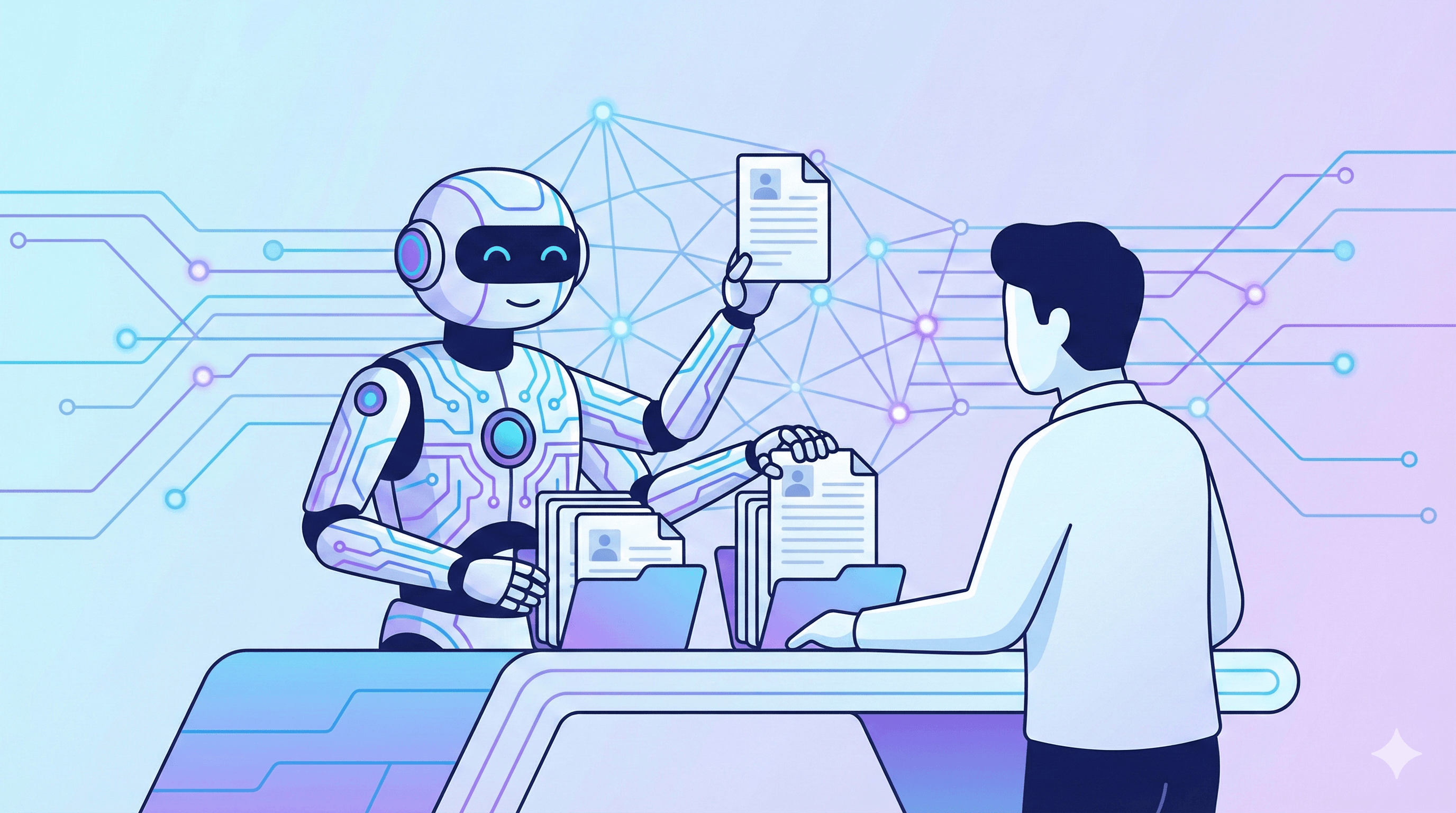
Applying for jobs can feel like shouting into a void. You spend hours tweaking a resume, filling out clunky forms, and writing yet another cover letter, only to hear nothing back. As Harvard Business Review notes, hundreds of other people click 'Apply' on the same postings. In 2025, the candidates who win are not always the best - they are the ones who treat job search like a system.
That is where an AI job application strategy changes things. Instead of copying and pasting the same resume into 20 portals, you use AI to scan roles, tailor documents, beat applicant tracking systems (ATS), and even submit applications automatically while you sleep. You stay focused on networking and interview prep while software handles most of the busywork.
In this complete guide, you will learn exactly how to use AI for job applications in 2025: how to set up your system, train it on your experience, scale to 50-100+ quality applications per day, and avoid the mistakes that get people filtered out. You will walk away with a repeatable playbook, not random tips.
Curious what a real AI job application system looks like end to end? See how GoApply uses AI to scan roles, tailor resumes, and auto-apply while you sleep.
Explore GoApplyCurious how an AI job application system actually works in practice? See a walkthrough of how GoApply automates resume tailoring, job matching, and auto-apply in one dashboard.
See GoApply WorkflowWhat is an AI job application in 2025?
An AI job application is a job application that is drafted, optimized, or even submitted with the help of artificial intelligence tools. In 2025, that usually means using AI to read the job description, adjust your resume and cover letter, choose the right keywords for ATS, and sometimes fill out the online forms for you.
Think of AI as a smart assistant, not a replacement for you. You still choose which roles to target, provide real achievements, and show up to interviews. The AI handles repetitive work and pattern-matching that humans are bad at doing hundreds of times in a row.
- Job discovery: AI scans job boards and company sites for matching roles.
- Fit analysis: tools score how well your skills align with each posting.
- Resume tailoring: your master resume is customized for each role.
- Cover letter drafting: personalized letters are generated for you to edit.
- Submission and tracking: forms are filled, and statuses are tracked in one place.
40+ hours
average time job seekers can save per week by automating applications
3x
average increase in interview invitations reported by GoApply users
95%
of AI-tailored resumes created with GoApply that pass basic ATS screening
Key idea
When you combine these pieces, you move from guessing and reacting to running a simple pipeline that works every day, even when you are busy at your current job or classes.
Why using AI for job applications is no longer optional
In 2025, most mid-level roles attract hundreds of applicants within the first week. Recruiters and ATS tools often screen out 70-90% of candidates before a human ever reads a resume. If you rely on a single generic resume and a few slow applications, you are competing against people running industrial-strength systems.
According to Forbes research on AI in hiring, over 90% of large employers now use applicant tracking systems and other screening software. Those systems reward candidates who match keywords, apply early, and submit clean, scannable documents - exactly the areas where AI gives you an edge.
- Apply at scale: AI can help you send 50-100 tailored applications per week instead of 5-10.
- Increase relevance: each resume and cover letter is adjusted to the exact role.
- Save energy: you avoid the copy-paste grind and spend your willpower on interviews.
- Use data: you track which types of roles respond, then double down on what works.
- React faster: AI can alert you and prepare materials as soon as a great role goes live.
Speed matters as much as quality. Large job boards have shown that applicants who apply in the first 24-48 hours often get more callbacks than those who wait. If you want deeper timing tactics, read our data-backed guide to the best time to apply for jobs.
How to set up your AI job application system (step-by-step)
Instead of treating every application as a new project, build a simple system you can run in about an hour a day. You design it once, then let AI do most of the heavy lifting.
Define your target roles and must-haves
Build a strong master resume
Gather measurable achievements
Choose your AI tools
Set guardrails and ethics
Pick a daily or weekly volume target
Schedule review and follow-up time
If you want a concrete volume plan, including how to protect your sanity, check out our guide on how to apply to 100+ jobs per week without burning out. It shows how to balance application volume with networking and rest.
Using AI to tailor your resume for every job
Sending the same resume to every role is one of the fastest ways to disappear into an ATS black hole. AI makes tailoring fast enough that you can customize your resume for almost every posting without starting from scratch.
The basic idea is simple: you feed the job description and your master resume into an AI tool, then ask it to highlight and rewrite your experience to match the role. You still review and edit the result, but you skip most of the manual work.
- 'Read this job description and my resume. Rewrite my summary to match this role, keeping my voice professional and concise.'
- 'Identify the top 10 skills mentioned in this job post and show where they appear in my resume. Suggest improvements.'
- 'Shorten this resume to one page for an early-career candidate without removing measurable achievements.'
- 'Rewrite these bullets to focus on impact, starting each with a strong verb and adding numbers where possible.'
Responsible for managing social media accounts for the company.
Grew social media followers by 42% in 12 months and increased average post engagement by 3.1x by launching A/B-tested content campaigns.
Once your content is strong, make sure the format is ATS-friendly. Avoid text boxes, images, and complex columns that can confuse scanners. For a deeper walkthrough, see our guide on how to make an ATS-friendly resume in 2025.
GoApply's AI Resume Tailoring feature automates this process at scale. It reads each job description, adjusts your skills and bullets, and keeps your tone consistent while boosting the keyword match. Users often see their resume-to-interview rate increase by up to 3x once every application is tailored.
Writing stronger cover letters with AI
Cover letters are still required or recommended for many roles in 2025, especially at competitive companies and for remote jobs. The good news is that AI can turn a painful blank page into a polished first draft in seconds.
You should never send a raw AI cover letter. Instead, use AI to build a tight structure and then layer in your real stories, numbers, and voice.
- Paste the job description and your resume, then ask: 'Draft a one-page cover letter that shows how my experience matches this role. Use a warm but professional tone.'
- Ask the AI to pull 2-3 specific achievements from your resume that best match the top requirements in the post.
- Request a shorter version: 'Turn this into a 200-word cover letter focused on my top two strengths for this job.'
- Finally, ask: 'Highlight any generic or buzzword-heavy phrases I should rewrite in my own words.'
If you want a tool built for this exact job, try our breakdown of an AI cover letter generator and how to get the best results from it.
You can also study proven cover letter examples for different industries to see how top candidates link their achievements to each employer's needs.
Avoid the AI 'wall of fluff'
Beating ATS and AI hiring filters
Applicant tracking systems and AI screening tools decide which resumes a recruiter actually sees. These systems score how well your application matches the job description, filter out obvious mismatches, and sometimes even rank candidates.
To beat these filters, you need two things: the right keywords and a format the software can read. AI is very good at both.
- Ask AI to extract the top skills, tools, and keywords from a job description.
- Have it compare those terms to your resume and highlight gaps.
- Let it rewrite a few bullets to naturally include missing but true keywords.
- Run your resume through an ATS checker to catch formatting issues.
For a deeper look at how these systems work, including bias and fairness questions, read our guide on AI in hiring and what job seekers need to know.
Platforms like GoApply include an ATS Optimization Suite that scans your resume against each posting, flags missing terms, and scores your match in real time. That kind of feedback loop turns guessing into a repeatable process you can improve week after week.
| Resume approach | Pros | Risks with ATS | When to use |
|---|---|---|---|
| Graphic-heavy template (columns, icons, images) | Looks modern and eye-catching to humans. | Some ATS tools strip or scramble content, causing key info to disappear. | For networking emails or after you are already in a hiring process. |
| Clean, text-based resume with clear headings | Easy for ATS to parse; simple to update with AI. | Can look plain if design is too bare. | For most online applications, especially large companies. |
| Two-version strategy (ATS-safe + visual PDF) | You get the best of both worlds for software and humans. | Takes more organization to keep versions synced. | For roles where you both apply online and share your resume directly. |
Scaling up safely: auto-apply without spamming
Once your materials are strong, the biggest win from AI is scale. Instead of sending 5 careful applications per week, you can send 50-100 highly targeted ones and still have time left for networking.
This is where AI job application tools that auto-apply come in. They connect to job boards and company sites, match roles to your profile, tailor your resume, and submit on your behalf. Used well, they save 40+ hours per week. Used badly, they spam the market and hurt your brand.
- Set clear filters for role, level, salary, location, and company size so the tool avoids bad fits.
- Require a minimum match score before any auto-apply happens.
- Review a sample of applications each week to confirm quality.
- Exclude companies where you want to do manual, ultra-custom outreach.
- Pair auto-apply with direct outreach on a few top roles each week.
GoApply's AI Auto-Apply Engine is built around this idea of quality at scale. It works with LinkedIn, Indeed, Glassdoor, and hundreds of company sites, applies only to roles that meet your criteria, and tailors your resume for each one. Many users report saving 40+ hours a week while getting 3x more interviews.
Imagine waking up to see that 50 tailored applications went out overnight, all tracked in one dashboard. That is what GoApply's Auto-Apply Engine and tracking tools are designed to do.
Try AI Auto-Apply FreeDo not let AI lie for you
Tired of juggling resume edits, job tabs, and spreadsheets? Let GoApply's AI handle the heavy lifting so you can spend your time on networking and interviews instead of forms.
Automate My ApplicationsTracking and improving your AI job search results
High application volume only matters if you learn from the results. Treat your AI-powered search like an experiment you adjust every week.
At a minimum, track what you applied to, when you applied, and what happened next. You can do this in a spreadsheet or with a dedicated job application tracking method.
- Applications sent per week.
- Interview rate by role type or industry.
- Responses by source (LinkedIn, Indeed, company site, referral).
- Time from application to first response.
- Offer rate per interview.
- Every Friday, export or review your application list.
- Group roles by type and see where interviews cluster.
- Adjust your targeting and keywords based on what gets responses.
- Schedule follow-up emails for promising roles.
AI can fill out forms, but it rarely sends thoughtful follow-ups. Build a habit of checking in one to two weeks after applying to roles you really like. Use our templates for how to follow up after applying so you can do this in a few minutes.
GoApply includes an Application Tracker Dashboard that logs every auto-applied role, tracks status changes, and shows analytics on which types of jobs turn into interviews. That kind of visibility makes it much easier to steer your search instead of guessing.
Common AI job application mistakes to avoid
AI can speed up your job search, but it can also amplify bad habits. Avoid these common mistakes so your AI job application system helps instead of hurts you.
- Sending obviously AI-written text full of generic buzzwords and no real numbers.
- Letting tools invent experience, degrees, or skills you do not have.
- Ignoring instructions in the job post, such as portfolio links or custom questions.
- Relying 100% on auto-apply and skipping networking, referrals, and direct outreach.
- Blasting out low-quality applications to every posting, including poor fits.
- Using the same prompt for every role instead of feeding the exact job description.
- Forgetting to prepare for interviews because you assume AI will somehow close the job for you.
Once AI does its job and you start getting responses, shift your energy to interview practice. Our guide on how to prepare for a job interview in 24 hours will help you turn those AI-assisted applications into actual offers.
Best AI tools for job applications in 2025
There is no single best AI tool for every step. The strongest setup uses a mix of general AI and specialized job search tools that work together.
Here is a simple way to think about your stack: what do you do manually today, what can a generic AI handle, and where does a specialized platform save you the most time?
| Use case | Manual approach | Generic AI tools | Specialized platform (e.g., GoApply) |
|---|---|---|---|
| Drafting resumes and cover letters | Write everything from scratch for each job. | Faster drafts but you still paste into job sites and track by hand. | Automatically tailors resumes and cover letters for each posting and keeps everything organized. |
| Finding and filtering roles | Search multiple job boards daily and skim every posting. | Can help summarize descriptions, but you still search and filter. | Scans LinkedIn, Indeed, and company sites, then surfaces roles that match your saved criteria. |
| Submitting and tracking applications | Click through every form and update a spreadsheet. | Little help here; still a lot of manual clicking. | Auto-applies within your rules and logs every application in a central dashboard. |
If you are still deciding where to focus your search, compare the strengths of major job sites in our guide to Indeed vs LinkedIn vs company career pages. Once you know your channels, you can let AI handle much of the repetitive work inside them.
For roles where networking matters, pair automation with a smart LinkedIn job application strategy. AI can help you write outreach messages and posts, but real relationships still move your resume to the top of the pile.
For many people, the question becomes whether to stitch together free tools or pay for something integrated. GoApply offers a free tier so you can test the workflow with a limited number of applications. The Pro tier unlocks unlimited auto-apply and full AI features for less than most single career coaching sessions, often helping people land jobs weeks faster - worth thousands of dollars in salary.
AI job applications for remote work, layoffs, and career changes
AI can be especially powerful if you are targeting remote roles, recovering from a layoff, or changing careers. These situations often require more applications and sharper positioning, which is exactly where automation helps.
For remote roles, you are competing with candidates across the country or even the world. Use AI to highlight your communication skills, async collaboration, and self-management. Our dedicated remote job application strategy digs deeper into how to stand out in global talent pools.
If you were recently laid off, AI can help you quickly reframe your experience and spin up large numbers of targeted applications in a short time. Just make sure your resume and cover letters stay honest about dates and titles; focus on what you achieved, not on the fact that the role ended.
For career changers, AI is great at translating your past work into the language of a new field. Feed it both your old resume and several job descriptions from your target industry. Ask it to highlight transferable skills and suggest new wording. You still decide which story feels authentic, but you no longer start from a blank page.
The future of AI in hiring (and how to stay ahead)
AI on the employer side is getting more sophisticated every year. Tools can already screen resumes, score assessments, and even analyze video interviews for keywords and behaviors.
That might sound scary, but it actually gives you a clear playbook: learn how these systems work, then design your materials to help them see your real strengths. That means clean structure, clear skills, measurable results, and language that matches the job.
In 2025 and beyond, the safest bet is to treat AI as a partner. Let it handle volume and pattern-matching, while you focus on the human pieces: networking, learning, and telling honest stories about your work.
Conclusion: Turn AI into your unfair advantage
An effective AI job application system does not replace your effort; it multiplies it. Instead of spending all your energy on forms and minor edits, you let AI handle matching, tailoring, and submission so you can spend your best hours preparing for conversations that move your career forward.
In this guide, you learned how to turn AI into a job search engine: from setting up your pipeline and tailoring resumes and cover letters, to beating ATS filters, scaling with auto-apply, and tracking what works. Used with care, AI lets you apply to 100+ roles in the time it once took to apply to one - without letting quality drop.
If you are ready to stop treating your search like a part-time job and start treating it like a system, consider trying GoApply. It combines AI resume tailoring, ATS optimization, smart job matching, and true auto-apply in one platform, so your AI job application workflow runs on autopilot while you focus on interviews.
Frequently Asked Questions
What is an AI job application?
Is using AI for job applications considered cheating?
How do I use AI to tailor my resume for each job?
Can AI write my cover letter for me?
Will ATS or AI detectors reject AI-generated resumes?
How many jobs should I apply to with AI each day?
What should I do after an AI tool submits my applications?
Is GoApply better than using free AI tools alone?
Can AI help international or remote candidates land jobs in 2025?
What are the risks of AI job application tools?
If you are serious about using AI for job applications in 2025, do not stop at theory. Put an integrated system to work so you can stop applying and start interviewing.
Start Free With GoApply