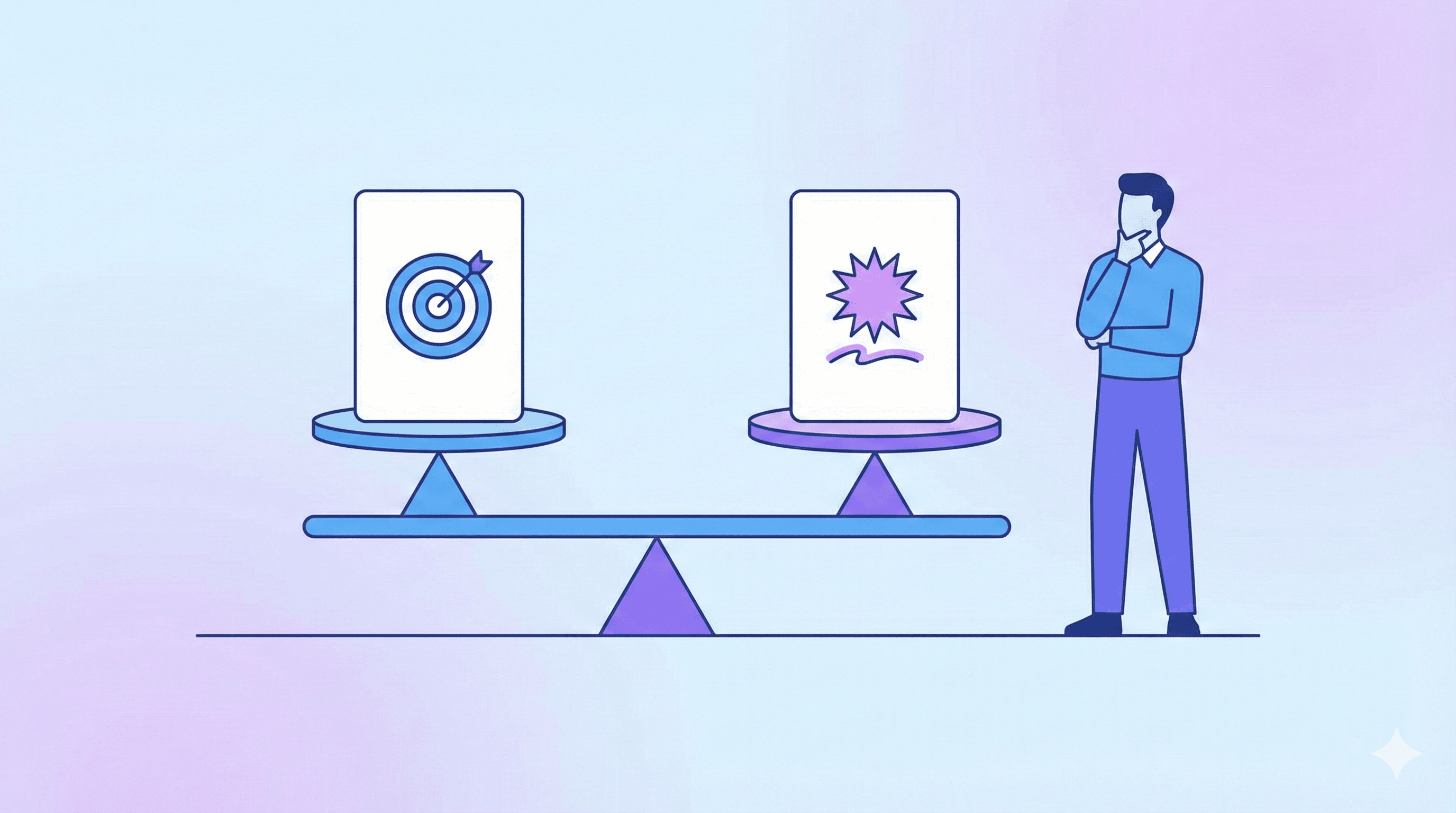
You know the top of your resume matters, but should you use a resume summary or a resume objective? According to Indeed's resume experts, most advice online is outdated, and using the wrong one can quietly cost you interviews-especially in 2025, when recruiters skim fast and ATS bots filter even faster.
This guide walks you through, in plain language, exactly when to use a resume summary vs an objective, how hiring managers read them today, and how to write each one step by step. You'll see real examples for students, career changers, and experienced professionals, plus tips tailored to 2025's AI- and ATS-heavy hiring process.
By the end, you'll know-confidently-what to put at the top of your resume for your situation, and how to make it strong enough that both software and humans stop scrolling and start reading.
Not sure if you should use a resume summary or objective? Save a few examples you like as you read-you can turn them into tailored versions for each job in minutes.
Skip ahead to examplesCurious what a strong, modern resume summary looks like for your situation? Scan the examples below and borrow a structure that fits your story.
See real examplesWhat Is a Resume Summary?
A resume summary is a short, 2-4 sentence paragraph at the top of your resume that highlights your most relevant skills, experience, and achievements for a specific role. It answers one key question for a recruiter: "Why should I keep reading this resume?"
Instead of listing what you want, a resume summary focuses on what you can offer. It usually includes your job title or field, years of experience, a few core skills, and one or two impressive results, often with numbers. Think of it as your 8-second pitch at the top of the page.
6-8 seconds
Average initial time a recruiter spends scanning a resume (Ladders eye-tracking study)
>95%
Share of large companies using an ATS to screen resumes (Jobscan research)
2.3x more interviews
Increase job seekers got when tailoring resumes to each job (ResumeGo study)
In a world where recruiters skim for just a few seconds and software pre-screens most applicants, a targeted resume summary gives both the ATS and the human reader a clear signal that you are a strong match right away. If you're mid-career or beyond, it's usually your best choice.
What Is a Resume Objective?
A resume objective is a 1-3 sentence statement that explains what kind of role you're seeking and, ideally, how you plan to add value. It traditionally starts with phrases like "Seeking a position as..." or "To obtain a role in...".
Objectives used to be standard, but many became vague and self-focused: "Seeking a challenging position where I can grow my skills." In 2025, that kind of objective hurts more than it helps, because it tells the employer what you want without showing what you can deliver. Done right, though, an objective can still help students, career changers, and people re-entering the workforce clarify their direction.
| Aspect | Resume Summary | Resume Objective |
|---|---|---|
| Main focus | What you offer the employer | What role you want (plus how you'll contribute) |
| Best for | People with 2+ years of relevant experience | Students, career changers, people with big gaps |
| Tone | Value-driven and results-focused | Goal-driven; must be very specific to work well |
| Length | 2-4 sentences | 1-3 sentences |
The simplest way to remember the difference: a resume summary looks forward using your past results, while a resume objective looks forward using your future goals. Employers care most about results, which is why, for most professionals, the summary has become the standard in 2025.
Resume Summary vs Objective: Key Differences in 2025
In 2025, the default choice for most job seekers with experience is the resume summary. Objectives still have a place, but only in specific situations. The core differences come down to focus, credibility, and how modern hiring tech reads your resume.
- Focus: A resume summary focuses on the employer's needs; an objective often focuses on your needs.
- Proof: Summaries lean on concrete achievements; objectives often talk about hopes and goals.
- Keywords: A good summary packs in role-specific keywords that ATS systems love; generic objectives rarely do.
- Perception: Recruiters see strong summaries as professional and modern; they see weak objectives as dated and vague.
AI tools and Applicant Tracking Systems scan your top section to guess your seniority and fit. If you want that software to rank you higher, you need a keyword-rich, value-focused summary that mirrors the job description. For a deeper dive into how algorithms read your resume, see our guide to an ATS friendly resume in 2025.
AI screening is also changing hiring itself. According to research on AI in hiring, more companies now use automated screening, chatbots, and ranking tools before a recruiter ever sees your resume. That makes your top few lines-summary or objective-the most scanned real estate in your entire application.
Rule of thumb for 2025
When to Use a Resume Summary
You should almost always use a resume summary if you already have relevant experience and your career story is fairly straightforward. It lets you frame that experience in a way that matches the role you want next.
- You have 2+ years of experience in the same field you're applying to.
- You're staying in roughly the same industry or function (for example, sales to sales, or developer to developer).
- You're applying for mid-level, senior, or executive roles where results matter more than raw potential.
- You have several quantifiable achievements you can highlight in one or two sentences.
- You want to show a clear career progression (intern → associate → manager, etc.).
Make your summary job-specific
If you're a senior leader, your summary is where you show scope and impact-budget size, team size, and big wins. Pair it with a specialized executive resume layout so hiring committees can see your leadership story at a glance.
In technical roles, a summary is also the best place to anchor your stack and domain focus before you dive into bullets. Our technical resume examples show how software engineers and data scientists combine a sharp resume summary with quantified project wins to stand out in crowded tech pipelines.
When to Use a Resume Objective
A resume objective can still work in 2025-but only when your background doesn't clearly match your target job on its own. In those cases, you need to explain your direction quickly before a recruiter makes assumptions based only on your work history.
- You're writing an entry level resume with little or no formal work experience.
- You're making a major career change (for example, teacher → UX designer, or accountant → software engineer).
- You're returning to work after a long employment gap and need to explain your new focus.
- You're pivoting into a very specific niche or new industry that your past titles don't reflect.
- You have a non-traditional path (bootcamps, freelancing, self-taught) and need to anchor your target role clearly.
If you're a student or recent grad, a focused objective can be more honest and effective than a weak summary that tries to stretch limited experience. Our guide to building an entry level resume shows how to pair a tight objective with projects, coursework, and activities that prove your potential.
For big pivots, you'll often combine an objective with a dedicated skills and projects section. See our career change resume guide for step-by-step advice on how to reframe your past work so a new industry sees your transferable skills instead of just your old titles.
If time away from work is your biggest concern, your objective can briefly connect your gap to your new direction. Pair it with the strategies in our guide on explaining an employment gap so the top of your resume feels confident and future-focused, not apologetic.
How to Write a Strong Resume Summary Step by Step
A great resume summary is specific, brief, and packed with proof. The easiest way to write one is to follow a simple formula and build it in steps instead of staring at a blank page.
Choose a clear target job title
List 3-5 core skills the job description repeats
Pull 2-3 achievements with real numbers
Match key keywords from the job description
Draft 2-3 sentences combining title, skills, and results
A simple formula you can follow is: Job title + years of experience + top skills + 1-2 quantified achievements + target keywords. This structure works across roles, from marketing to engineering to operations.
Hardworking marketing professional seeking a challenging position where I can use my skills and grow with the company. Team player with strong communication skills and a passion for digital marketing.
Digital Marketing Manager with 6+ years of experience driving paid and organic growth for B2B SaaS companies. Led campaigns that increased qualified pipeline by 48% and reduced CAC by 22% in 12 months. Skilled in SEO, paid social, marketing automation, and A/B testing.
The bad summary is about vague traits-"hardworking," "team player"-that any applicant could claim. The good summary uses specific results and context: industry, metrics, and tools. To make your own summary this strong, learn how to quantify achievements on your resume with clear numbers and outcomes.
- Use strong action-oriented phrases ("led," "built," "launched") instead of soft ones ("helped with"). Our list of resume action verbs can help.
- Avoid first-person pronouns like "I" and "my." Start with your role instead: "Project manager..."
- Stay realistic: focus on 1-3 things you're truly best at, not everything you've ever done.
- Keep it skimmable. One compact paragraph is plenty; walls of text turn recruiters away.
Feeling stuck writing your resume summary? Draft a rough version using the formula above-later, you can refine or auto-tailor it for each job.
Jump to tools that can helpAlready have a draft summary or objective? Run it through AI and ATS tools to tailor the wording and keywords to each job you apply for.
Use GoApply's AI Resume TailoringHow to Write a Modern Resume Objective that Works
Most resume objectives fail because they only say what the candidate wants. A modern objective flips that: it states your target role, context for your background, and how you'll create value in that role-all in one tight sentence or two.
- Start with the exact job title you're targeting.
- Name your current identity (student, career changer, returning professional) and 1-2 relevant strengths.
- Mention 1 concrete proof point (project, result, or credential).
- End with how you aim to help the employer, not just what you want to learn.
To obtain a challenging position in a dynamic organization where I can use my skills, gain experience, and grow professionally.
Aspiring Data Analyst transitioning from teaching, seeking an entry-level analyst role where I can apply SQL, Excel, and Tableau skills to improve student outcomes and operational decisions. Completed a 6-month data bootcamp and built dashboards that cut reporting time by 40% for a local nonprofit.
The good objective is specific about tools, target role, and value ("cut reporting time by 40%"). The bad one could appear on almost any resume, for any role. If your objective reads like a fortune cookie, rewrite it until a stranger could guess what job you want and why you'd be good at it.
Make sure your objective lines up with your skills section right below it. If you claim you want a data analyst role but list no data tools, recruiters will move on. Use our guide to the resume skills section to choose skills that match your new direction and the job description.
Resume Summary vs Objective Examples by Situation
To make this real, here are resume summary and objective examples for common situations in 2025. Use them as templates, but always customize them to your own experience and each job posting.
- Recent graduate (objective): "Business Analytics graduate seeking a Business Analyst role where I can apply SQL, Excel, and Power BI skills to support data-driven decisions. Completed 3 capstone projects analyzing marketing and operations data, improving forecast accuracy by up to 18%."
- Recent graduate (summary, with internships): "Business Analyst with internship experience at a regional bank, supporting dashboards and ad-hoc reporting for risk and operations teams. Built SQL queries and Power BI reports that reduced month-end reconciliation time by 25%."
- Career changer to tech (objective): "Former operations manager transitioning into software engineering, targeting junior backend roles using Python and Django. Completed a 9-month coding bootcamp and shipped 4 full-stack projects, including an inventory app that cut manual tracking time by 60%."
- Experienced marketer (summary): "Senior Marketing Manager with 9+ years of experience in B2C e-commerce, specializing in paid social and lifecycle marketing. Drove 32% YoY revenue growth and lifted email-driven repeat purchase rate by 19% through segmentation and experimentation."
If you're in a field like marketing or finance, you'll want your resume summary to mirror the language of your industry. Our dedicated guides to the marketing resume and finance resume include more examples tailored to those paths, including bullet points you can adapt for your own experience.
- Returner after a layoff (summary): "Product Manager with 7+ years of experience in B2B SaaS, recently laid off due to company-wide restructuring. Led cross-functional squads shipping features that increased adoption by 23% and reduced churn by 9%. Skilled in roadmap planning, discovery, and stakeholder alignment."
- Parent returning after a break (objective): "Project coordinator returning to the workforce after a 4-year break for full-time caregiving, seeking a PMO Coordinator role where I can leverage prior experience managing $500K+ projects, cross-functional schedules, and vendor relationships."
- Remote job seeker (summary): "Customer Support Specialist with 5 years of experience in fully remote environments, supporting SaaS customers across US and EMEA. Maintained CSAT above 95% while handling 40-60 tickets per day via chat, email, and phone; experienced with Zendesk and Intercom."
- Software engineer (summary): "Full-Stack Engineer with 5+ years building and scaling web applications in React, Node.js, and PostgreSQL. Designed and implemented features that cut page load times by 40% and increased conversion by 15%. Comfortable owning projects from requirements through deployment and monitoring."
If you're targeting a remote role, your summary or objective should prove you can handle async work and time zones. Our remote job application strategy guide shows how to highlight remote-friendly skills so employers trust you even if they never meet you in person.
For engineers and other technical roles, read our full software engineer job search guide to see how a sharp resume summary fits into a broader strategy that includes projects, GitHub, and interview prep-not just a list of languages and frameworks.
Common Mistakes with Summaries and Objectives
Even strong candidates lose interviews because of small but costly mistakes in their resume summary or objective. Fixing these often has a bigger impact than changing fonts, colors, or templates.
- Using generic phrases like "hardworking," "self-starter," or "team player" with no proof.
- Writing a summary that's just a reworded skills list instead of including results.
- Copy-pasting the same top section for every job without changing keywords.
- Writing a self-focused objective that only says what you want to gain, not what you'll give.
- Including too much detail (5-7 lines of dense text) that recruiters simply won't read.
- Forgetting to match your summary or objective to the rest of the resume (for example, claiming project leadership with no related bullets).
Watch out for this red flag
Many of these issues show up across the whole document, not just the top. Review our list of common resume mistakes to catch problems like weak verbs, poor formatting, and beating around the bush about results before you send your next application.
Also keep an eye on length. If your summary or objective starts pushing your resume to three pages, shorten it. Most professionals are best served by a focused one-page resume or tight two-pager. Your opening should hook the reader, then get out of the way so your experience section can do its job.
Tools and AI Resources to Improve Your Resume Summary
You don't have to perfect your resume summary or objective alone. In 2025, there are powerful tools-from ATS scanners to AI writers-that can help you draft, refine, and tailor your top section for every role you apply to.
- ATS resume scanners to check whether your summary includes the right keywords and is readable by software.
- AI resume builders that suggest phrasing, action verbs, and metrics based on your job title and experience level.
- Job description analyzers that highlight repeated skills and phrases you should echo in your summary.
- Job application automation tools that help you apply to more roles while still tailoring your top section.
If you're comparing options, our breakdown of the best AI resume builders explains where generic tools fall short-and how to avoid summaries that sound like a robot wrote them. Look for tools that keep your professional voice while still optimizing for keywords and clarity.
GoApply is designed around this idea of smart automation. Its AI Resume Tailoring feature can create a customized resume summary for every job, weaving in the right skills and metrics without losing your authentic tone. Combined with the ATS Optimization Suite-which flags missing keywords and format issues-it helps your summary get past filters and in front of humans. GoApply users report 3x more interviews after switching to tailored applications.
If you're applying widely, GoApply's AI Auto-Apply Engine can also put your optimized resume summary to work at scale. It can send targeted applications to 50-100+ roles per day across LinkedIn, Indeed, and company sites, while you focus on networking and interview prep. For a complete walkthrough, see our guide to an AI job application strategy that doesn't burn you out.
As you scale your search, don't lose track of where you've sent each tailored resume. Our article on job application tracking shows simple ways to stay organized, from spreadsheets to dedicated dashboards, so you can follow up on the right opportunities at the right time.
Want your resume summary tailored automatically for every job you apply to? Let GoApply's AI do the heavy lifting while you focus on interview prep.
Try GoApply's AI Resume TailoringResume Summary vs Objective: Which Should You Use in 2025?
So, resume summary vs objective-what should you use in 2025? For most job seekers, the answer is clear: a resume summary is the stronger, more effective default. It focuses on the employer's needs, showcases your best results, and plays nicely with ATS and AI screening tools.
- Use a resume summary if you have 2+ years of relevant experience and a mostly linear career path.
- Use a resume objective if you're entry-level, changing careers, or returning from a long break and need to explain your direction.
- Keep both short, specific, and value-focused-no fluff, no clichés, and always grounded in skills and proof.
- Update your top section for each role so it mirrors the job description and the keywords the employer repeats.
Once your resume summary or objective is dialed in, the next big wins come from how you use it-applying to the right roles, at the right volume, and following up thoughtfully. Tools like GoApply can automate the repetitive parts of this process so you can focus on conversations, not endless form-filling. Its AI Auto-Apply Engine, Resume Tailoring, and ATS Optimization Suite work together to help your carefully crafted top section actually get seen.
If you're ready to move from tweaking your resume in isolation to getting real interviews, give yourself an edge: use a sharp, targeted resume summary, then let automation handle the grind. In a market where hundreds of people apply to each role, combining smart writing with smart tools is one of the fastest ways to move from applying to actually interviewing in 2025.
Frequently Asked Questions
What is a resume summary?
What is the difference between a resume summary and objective?
Should I use a resume summary or objective in 2025?
Can I have both a resume summary and objective on my resume?
How long should a resume summary be?
How do I write a resume summary with no experience?
What are some examples of a good resume objective?
Do ATS systems care about my resume summary or objective?
Where should a resume summary or objective go on the page?
Can AI tools help me write a better resume summary?
If you're serious about landing interviews faster, don't stop at writing a better resume summary-put it to work at scale with AI-powered applications and tracking.
Start automating your applications with GoApply